Prairie Yard & Garden
SDSU Local Foods
Season 36 Episode 2 | 28m 45sVideo has Closed Captions
Visiting the Local Foods Program at South Dakota State University in Brookings.
South Dakota State University in Brookings has made local foods a field of study to help students understand how to produce safe, healthy, and sustainable food for their community.
Problems playing video? | Closed Captioning Feedback
Problems playing video? | Closed Captioning Feedback
Prairie Yard & Garden is a local public television program presented by Pioneer PBS
Production sponsorship is provided by ACIRA, Heartland Motor Company, Shalom Hill Farm, Friends of Prairie Yard & Garden, Minnesota Grown and viewers like you.
Support provided by:


Prairie Yard & Garden
SDSU Local Foods
Season 36 Episode 2 | 28m 45sVideo has Closed Captions
South Dakota State University in Brookings has made local foods a field of study to help students understand how to produce safe, healthy, and sustainable food for their community.
Problems playing video? | Closed Captioning Feedback
How to Watch Prairie Yard & Garden
Prairie Yard & Garden is available to stream on pbs.org and the free PBS App, available on iPhone, Apple TV, Android TV, Android smartphones, Amazon Fire TV, Amazon Fire Tablet, Roku, Samsung Smart TV, and Vizio.
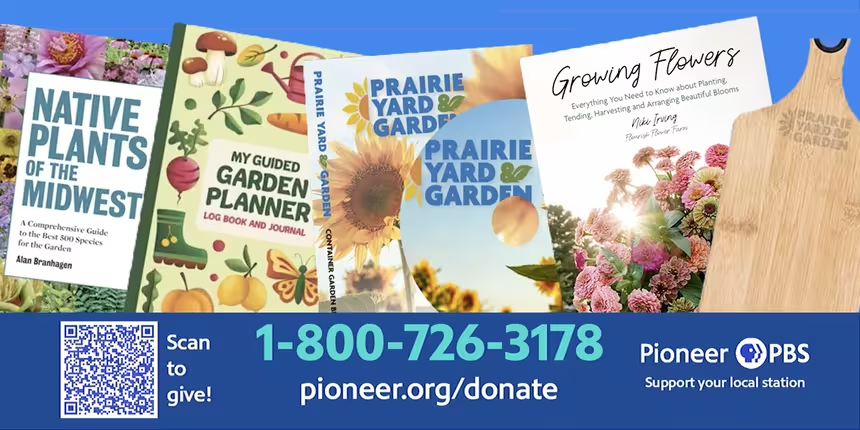
Prairie Yard & Garden Premium Gifts
Do you love gardening? Consider becoming a friend of Prairie Yard & Garden to support this show and receive gifts with your contribution. Visit the link below to do so or visit pioneer.org/donate.Providing Support for PBS.org
Learn Moreabout PBS online sponsorship(gentle music) - It seems like every year or two, we hear about a food recall of some type.
I remember going to the grocery store, and also a local restaurant, and there was no lettuce available due to possible contamination.
I'm Mary Holm, host of "Prairie Yard & Garden."
And come along with me today as we meet a teacher and students who are concentrating on producing healthy and clean local foods in a number of different ways that are all safe for us to eat.
- [Announcer] Funding for "Prairie Yard & Garden" is provided by Heartland Motor Company, providing service to Minnesota and The Dakotas for over 30 years in the heart of truck country.
Heartland Motor Company.
We have your best interest at heart.
(gentle music) Farmer's Mutual Telephone Company and Federated Telephone Cooperative.
Proud to be powering Acira, pioneers in bringing state-of-the-art technology to our rural communities.
Mark and Margaret Yackel-Juleen, in honor of Shalom Hill Farm, a nonprofit rural education retreat center in a beautiful prairie setting near Wyndham, Minnesota.
And by friends of "Prairie Yard & Garden," a community of supporters like you, who engage in the long-term growth of the series.
To become a friend of "Prairie Yard & Garden," visit pioneer.org/pyg.
(bright music) (bright music continues) - I have mentioned before how much I appreciate people giving me ideas for shows.
Several years ago, a friend named Suzette, told me I really should go and see the local foods program at South Dakota State University.
Then another friend named Bonnie said the very same thing.
Well, it didn't take me long to do some research and find out that Brett Owens was in charge of the program.
And when I called him he said, "Sure, come for a visit."
So we loaded up the "Prairie Yard & Garden" crew, and here we are.
Hi, Brett.
- Hi Mary.
We're very happy to have you here at the Local Foods Education Center today.
The Local Foods Education program is a new curriculum that was started about 10 years ago in order to help students and community members learn a little bit bit more about food insecurity and how we can teach the students in the communities to grow different types of foods, maybe a little bit more nutrient dense, using some different techniques than standard techniques, in order to provide good healthy food to people of our state.
- How did the program get started?
- The program actually started at about 2012 with a small little student garden.
We just had some interest from some of our horticulture students, and we got a small plot of land, just east of town a little ways, and we started growing food.
And it turned out that very first year to be extremely successful, and students were like, "Yes, we want to continue doing this."
So over the next few years, we looked at creating an an actual farm, directly on campus here at South Dakota State, which grew into what we have now.
Our main goal is to help fight food insecurity.
So in South Dakota, food insecurity is a term that we use for people that don't have access to good, healthy food.
And when you don't have that, obviously, there could be some medical issues as well.
So in South Dakota at the time, food insecurity was about 12.9%.
And we are working to teach, not only the students to go back out into their hometowns to do this, but any communities that are interested to come by and learn some of our techniques to help provide that good, healthy food.
- [Mary] Your students, where do they come from?
I mean, do they have to be horticulture students in order to participate?
- [Brett] Absolutely not.
Truth be told, most of the student workers that we have had have come from other areas within the university.
We've had nursing students, we've had engineering students, dietician students.
Anybody that wants to learn, we'll be here to teach them.
- Well, would it be possible to meet some of them too?
- Yes, absolutely.
We've got a good crew this year that would love to talk to you.
(bright music) - Hi, Mary.
I'm Ashdyn Schultz.
I am a senior horticulture student here.
- Ashdyn, what brought you to this program?
- Well, funny enough, I am a non-traditional student.
I knew I wanted to work outside and then when I came here I met with Brett, and I really liked his vision with helping with food insecurity.
And it's great to me, because I'm from Brookings, and so to be able to be in my community and kinda have a little piece in that, is really great.
- What do you mean by a non-traditional student?
- So I went to college, I dropped out, and then I spent a couple years working, and then I realized that if I really wanted to find my passion, then I want to go back to school.
And I have found that with horticulture.
I am, I love it.
It's so nice being outside, it's a great day here, and to be able to help people grow things, too.
I mean, plants, in my opinion, help everybody, you know?
Whether it's food or, you know, inside, and I wanna be a part of that.
- Well, this is so great.
Thanks for telling us about it.
And then, can we meet some of the other students too?
- Yeah.
We've got six students working here this summer, and I think they're busy behind us, so, let's meet 'em.
(bright music) - I'm Abby Mueller.
I'm an ag education major with a minor in animal science.
My biggest goal is, when I moved here from Wyoming, and being an ag teacher, I really want to do that farm to table.
I wanna be able to incorporate that, whether that's the lunchroom, whether that's something bigger.
That's kinda my main goal about being here.
- [Mary] I know we're at South Dakota State University, but where on the campus are we?
- [Abby] So we're right off Highway 14.
The goal is that we can get students that are living on campus just straight into here, so that they can be a part of it.
- [Mary] So this isn't very far from where the students go to school and take classes and also live?
- [Abby] Yeah, not at all.
We've got campus housing all over the university, so it's kind of different from each place, but, maybe a five, 10 minute walk.
So Mary, we're here sitting on 1.2 acres.
We've got, our whole goal is sustainability.
So we've got our raised beds here, which are all made out of storm doors, and then we've got refurbished lumber, which are in-ground raised beds, and then we've got quite a variety of vineyards, so grapes, potatoes, squash, carrots.
Anything you can name of, we grow it.
We'll start 'em out in the greenhouse, and then we'll move 'em out when they're ready to get in here.
Towards the summer, we can start planting in the ground, too, if it's like, later season that we're starting.
But we do quite a mixture of the two.
So Mary, obviously we live here in South Dakota where the climate isn't really conducive for growing year round.
So a couple years ago, we decided to implement using a high tunnel.
This allows us to start growing in March, and then continue on till the end of Thanksgiving.
- [Mary] Which really, really extends your season of production.
- [Abby] It does.
It really does.
- Well, you mentioned greenhouses.
Would it be possible to see your greenhouse, too?
- Yeah, definitely.
We could definitely take you there.
(gentle guitar music) - In the summertime, strawberries make everything more delicious.
What a versatile fruit.
In salads, desserts, or as a snack, strawberries add color and flavor to just about everything.
I think the other reason we love strawberries so much is because they are a seasonal fruit.
We often look forward to the time they are ready to pick.
And unlike other fruits, their peak season lasts only two to three weeks, so we need to get out there and pick them when they're ready.
And strawberries is why we've come to Pine Tree Apple Orchard in White Bear Lake, Minnesota.
While they have apple in the title, you can bring your whole family here to pick strawberries, purchase anything made with strawberries, and learn about some delicious recipes to make your own strawberry treats.
Besides apples, Pine Tree Apple Orchard has branched out, with additional fruit-related products and activities.
Bill Jacobson heads many of the farm's growing operation, including strawberries.
- It's homegrown, you know?
And I've been around North America at a lot of different strawberry farms, and when they're vine ripened, they're all pretty good.
But there's something about our soils and climate in Minnesota that make exceptional fruit.
- [Mary] Strawberry picking is a fun, family activity.
But here are some tips you should consider when planning your visit to pick-your-own strawberry patch.
- Well, I think the most important thing is to call before you come.
Even though you're maybe thinking they're open tomorrow, you know, when the day comes, just call to make sure, 'cause strawberries are very fickle, and they don't all ripen at once, and you want to avoid a fruitless trip.
- [Mary] Whether you enjoy fresh, locally grown strawberries soon after they're picked, or preserve them for later, there are some helpful hints to ensure your strawberries are full of taste.
- [Bill] We suggest that before you use them, to rinse them off, keep the stems and the caps intact too, right?
Until you're ready to use them.
They'll stay fresher that way.
And one neat tip is if you wanna freeze the berries whole, on cookie sheets, then bag 'em after they're frozen, you can pull out just the amount you want.
- I can personally say that a trip to a strawberry patch is a wonderful way to spend a mid-summer morning.
If you'd like to learn more about strawberries, or where to find pick-your-own strawberries in your area, visit minnesotagrown.com.
- I'm Amelea Jones, and I'm the manager at Local Foods Education Center, and today we are at the Horticulture and Forestry building, where we have our greenhouse base.
So all of these bays all run on the same system, but they can be different temperatures and you're allowed to grow different things.
If one bay gets an infestation of gnats or something, then it secludes it off, so that's something that is really beneficial for making sure that we have different people growing here, so it's not gonna interfere with other people's projects.
- Well, it's warm in here today.
I can't imagine, what do you do to keep it cool enough for the plants in here?
- So each bay has its own fan and its own system.
So, it runs on the same system, but it can be different temperatures, each bay.
And the fans kind of cool it down and then we have a water system on the side of it that cools it down also.
- [Mary] How early do you start plants here in this bay?
- [Amelea] This year, I believe that we started them in March.
It's kind of a succession planting, so you don't start things all at the same time.
Cucurbits are a lot different than tomatoes and all the other kind of plants.
So it's all kind of depends on the type.
- So, is that in order to give you more growing space and more growing time?
- Yeah.
So usually you can start such as, like, cucumbers and melons outside and people hill them, but for us, it's easier to start them in here and then transplant them outside, because our season starts kind of later than we were wanting to, so starting them at different times is easier for us to plant later.
- [Mary] So, how do you decide what to grow?
- [Amelea] That's kind of a decision based on all the kids.
This year, I kind of got to decide that.
That was really fun.
So, I got to decide the types and what we were gonna do, but talking to the kids and our workers is something that's really important, and making sure everyone's on the same page.
- [Mary] How do you decide what to grow?
- [Amelea] It's kind of based on the community, actually.
So we donate a lot of our stuff, so things that people wouldn't know what to do with, it's kind of staying away from.
I like the fun things.
So there are a few things in here that people probably will have never seen before, but making sure that people have nutrient-dense produce, to make sure that they have food on the table, is kind of the biggest thing that we worry about.
And that's why I chose some of the things that I chose.
- And how long do the plants stay in here, then?
- Until they're ready, pretty much.
Usually on the back of the seed packets, we're able to kind of determine when our planting date is.
So ours was May 20th, but it kind of was pushed back.
But, I had everything ready to go by then, so usually if it says four weeks, I'll start at just right at that time, so.
It's kind of based on what's given to us on the pack of the seeds.
- [Mary] Then, do you have to work on weekends to water, too?
- [Amelea] Yeah.
So usually, we're able to hire on early, and we have part-time workers, and they can come in.
Somebody waters every day, at least once a day, unless it's really warm.
Then we have a morning and a night, and then on weekends it's usually managers, but we have had a lot of help this year, so it's been pretty nice kinda, to get everyone to help us water.
- What do you do with all of the produce that you get from this program?
- So, our program is mostly based on donations.
It's fully based on donations, but it's mostly based in Brookings.
So, we go to the Carriage House, the Boys & Girls Club, and the Harvest Table, mainly.
Those are our three main things.
And then, we donate those as fast as we can get them picked, and then out the door as fast as possible.
And also, we send a lot home with our workers and their families, because they know a lot of people that are a part of the food insecure percentage, so it's kind of give it to whoever is willing to take it and whoever is willing to try some new things.
- You mentioned nutrient-dense foods.
What does that mean and what are those?
- So, a lot of times, people believe that fruit and vegetables are the best.
And I agree.
But, a lot of times they are water and, like, celery.
You'd think of celery and it's a very water, kind of based fruit, and all vegetables too.
But potatoes are especially very dense, so if you were to eat like, potato wedges, that would fill you up really fast.
And then I chose some specific squashes that are gonna be better.
One of them was an angel hair spaghetti squash.
So instead of eating pasta, which sometimes people can't afford, we can donate these free squashes.
They're basically like spaghetti.
- [Mary] Would it be possible to visit with some of the other students that have a project in here, so they can tell me about what they're growing?
- [Amelea] Yeah, of course.
(bright music) - I'm Jolie Femrite, and this is my personal project here.
I'm growing beans and peas, and my goal with it is to see how they grow in the greenhouse setting compared to like, my personal garden at home.
- How long ago were your plants planted?
- About a week ago, now.
- [Mary] Oh my gosh, they're so nice.
Did you have to put new soil in here or was the soil already here?
- Yeah, yep.
We replace it each year, just to make sure it's good for the plants to grow in and has all the things they need.
- How do you get the soil out and bring the new in?
- We shovel it out actually, by hand.
So, it's a little bit of a process, but very necessary and good for the plants.
- [Mary] That's a lot of work.
- Yeah.
(chuckles) - [Mary] And I see that you have some trellises here, so that the plants can crawl up the trellises?
- [Jolie] Yep, yep.
Also, like, one of my interests with the project is to see how high they'll grow on these trellises compared to my trellises at home.
- [Mary] When you planted these, are these bush beans or are they pole beans?
- [Jolie] They're pole beans.
- [Mary] And what's the difference between the two?
- So, a bush bean will stay short and bushy, kind of like the term, you know, sounds, and then a pole bean will, like a pole, it'll grow up the trellising, which is why we have this here.
- [Mary] And, what do you hope to use this knowledge for?
- [Jolie] It's just like, for experimental purposes.
I just wanna see like, what their capabilities are.
- [Mary] When you started these plants and these seeds, you planted them by seed?
- [Jolie] Yep.
- [Mary] How far apart did you space the seeds?
- [Jolie] About three inches.
Two to three inches.
- [Mary] Okay.
Then, do you have to come in and water these quite often?
- About once daily.
So in the mornings, I'll come in here and water them.
- How about fertilize?
Do you fertilize 'em, too?
- We do not.
- Really?
Is there any fertilizing added to the soil at all or are they just on their own?
- Nope, nope.
Just on their own.
Just the soil mix.
- Well, you're gonna have to let me know how this turns out.
It sounds really fun.
- [Jolie] Yeah.
(gentle music) - I'm Elizabeth DeBoer.
I'm from Clear Lake, South Dakota, and I'm majoring in horticulture here at South Dakota State University.
- Elizabeth, is the Local Foods Program, is that a major, also?
- It's not a major, but there is a Sustainable Local Foods minor that can be acquired here at SDSU.
It just consists of a couple different horticulture classes and then two nutrition classes as well.
- What do you hope to use this education for?
- I'm really not sure what I wanna do with my horticulture major, so I'm trying to use this as an avenue to explore, maybe see if this is a career that I wanna do, later on in my future.
And even if that's not the case, then just learn a little bit more about gardening so I can take that into my future life, too.
- And how many hours a week do you work here in the program?
- I'm full-time, so just around 40.
- [Mary] Well, thanks so much for joining us and this has been really interesting.
- [Elizabeth] Thank you.
(bright piano music) - I have a question.
What are the most important steps in planting perennials?
- Perennials are great plants for Minnesota gardeners.
And one of the reasons is that they come back every year, reliably.
And, this plant in particular is called a wood's aster, Wood's Purple Aster.
This is a great plant, it grows in full sun, it's in full bloom now in the fall.
A bee magnet, absolutely.
And look at the color.
It's fantastic.
So, I bought this at one of my local nurseries and I am going to take it out of the pot.
I'm gonna hold my hand around the crown of the plant.
I'm not gonna squeeze it, I'm gonna just slide it out of this pot.
And you can see that the roots are very compacted on here.
This is a very pot-bound plant.
So before I plant it, we wanna loosen up these roots.
This plant has been growing in its container for quite a while, and by doing that, you can just scratch it with your fingers like this, to loosen it.
You can see they start to break up a little bit.
You can also use a pruner and you can just scratch like this, as well.
Once you've loosened the roots up, then you wanna check your hole.
You wanna dig your hole and check the depth of it.
You wanna plant this plant at the same depth as it was in the pot.
So we are gonna check it here in the hole, set it down in there.
It looks pretty good.
It's even with the soil.
And once we've done that, we can just start to plant it.
We can just fill it back in.
So back fill in with the same soil that you dug out of the hole.
Just pat it down, press it down, and then you wanna be sure that you water it in.
Watering not only helps reduce transplant shock to the plant, but it also helps to settle the soil in around the roots.
Once you're done with that, you wanna mulch around the plant, put your mulch back.
Mulching will help to hold in moisture, as well as reduced weed pressure.
And last but not least, be sure to put your tag in with your plant.
(gentle piano music) - [Announcer] "Ask the Arboretum Experts" has been brought to you by the Minnesota Landscape Arboretum in Chaska, dedicated to welcoming, informing and inspiring all, through outstanding displays, protected natural areas, horticultural research and education.
(gentle piano music) - Hi, I'm Joe Tilstra and I'm another manager here at Local Foods.
And I'm in charge of the hydroponics and aquaponics for our school here.
- Joe, what is the difference between hydroponics and aquaponics, and can you explain it to me or teach me about that?
- Yeah, sure.
So, the main difference between aquaponics and hydroponics is the use of fish for nutrients.
So in hydroponics, you have just store-bought nutrients that are in the water, and the plants go and you know, take that up.
But in aquaponics, you're using the nutrients that the fish are providing for the plants.
So, this is a hydroponic system.
They call it a Dutch bucket system.
And, as it works, it takes nutrients from a reservoir down here, and then it slowly drips 'em down into the plants.
And then, in here is where we keep the plants, and this is just a mixture of lava rock and perlite, and that just acts as a way for the plants, you know, to grip onto something so they can get their roots out and get the water.
Yeah, just inside this little thing is a little okra seed and eventually this'll grow into a big plant that'll be able to produce okra for everybody.
- Can you reuse that rock from one year to the next?
- Yep.
We do reuse all of our rock, and you just have to go through a sanitation process to, you know, get any bad junk off of it or diseases that had been piling up over time.
I use a 10% bleach solution, and then I wash 'em, and then I let 'em bake in the sun for a little bit so the UV rays will kill anything that's left over.
- [Mary] How long do the plants actually stay in this?
Do they stay from seed to full production?
- [Joe] Yep.
It's all one plant right in there, you know?
You just, you start it right in the pot and then they'll grow up and yeah, you harvest right from there.
- Okay.
Now, how about aquaponics?
- So, in aquaponics we have, usually fish on the bottom is how we like to do it.
And then, the nutrients will go through the fish, and that gets pumped up to a bed and above it, where they will end up having, like, the plants will end up being inside the water and they'll grow roots down and through it, and then that bed also functions as a filter to get out all like, bad substances that are in it.
It's mainly like, ammonia and yeah, so nutrients will be taken out of the fish water, and then the fish will have nice clean water and the plants will have nutrients that they need.
We have to take the chlorine out of the water, otherwise the fish will not like, do very well.
It really stresses 'em out and can even potentially kill them.
We have had problems in the past where, we didn't know that there was so much chlorine that was gonna be in the water, and it ended up, we lost a couple of fish and that was kind of a sad deal, you know?
So.
- [Mary] Are there certain kinds of fish that you have to use for the system?
- [Joe] No.
Any fish will work.
We use goldfish.
We're even using like, a lot of common house like, fish, you know, angelfish, goldfish.
We had some platties at one point and we had a big tank which held like, 25-year-old coy and those really worked well, too.
A lot of people use tilapia or other fish that you can like, eat after you grow 'em up for a couple of years.
Then you get the added benefit of the protein from the fish and, you know, all the nutrients from the plants.
- [Mary] Where do you get your fish from?
- [Joe] The house fish we got from an aquarium locally in town.
But yeah, as for things like tilapia, you have to get them offline.
- [Mary] How long do you keep the fish and grow here?
- [Joe] It depends.
For, in the future, once we get, you know, like, tilapia or something, those will only be a couple of years because you don't want to grow 'em for too long 'cause then, you know, the meat starts to taste weird.
But yeah, like, the coy and the other like, more decorative varieties that you're not meant to eat, those you can keep forever and just keep using 'em over their natural lifespan.
- [Mary] Do you keep this active in the winter, too?
- [Joe] We try to.
We run into problems with light.
It's warm enough in here to grow plants, but yeah, it's more of a light issue, so, you know, when it gets to the dead of winter, that January, December area, you know?
There's not really enough light to get the plants going without any supplemental light.
Once you get into that spring, early spring season, when the light really starts, the days are lengthened like, eight hours or so, stuff really just takes off from there, so.
- [Mary] What do you do with your fish in the wintertime?
- [Joe] We keep 'em in here since it's heated in this greenhouse so, they really don't have too much of a problem, just feed 'em, you know.
Business as usual, basically.
- [Mary] Do you have to feed the fish food in addition to the nutrients in the water?
- [Joe] Yep.
That's where most of the nutrients come from is, that's the only input really, for aquaponics is, you know, the fish, and they digest that, and that's how the nutrients get into the water for the plants.
We just feed 'em just, generic fish food.
So yeah, they do all the other work themselves, them and the bacteria in it, so.
- [Mary] How often do you have to feed the fish?
- [Joe] Daily.
- Okay.
- Yep.
- [Mary] One time?
- [Joe] One time a day, yep.
- [Mary] Okay.
- But yeah, it depends on some species and different like, age.
You know, if they're real young you're gonna wanna feed 'em a couple times a day, 'cause they really need that nutrients to get themselves growing and stuff, so.
- Are there some plants that work better in an aquaponics and a hydroponic system than others?
- Yeah.
A lot of times, especially like, now, as it's sort of a newer thing, you know?
A lot of times people will grow herbs, they'll grow leafy greens, and then, with certain types, like Dutch buckets, a lot of people use viney plants for that.
So you got your cucumbers, and you know, peas and stuff like that.
But yeah, mostly, the most common things to grow are salad greens and herbs right now.
- [Mary] And why is that?
- [Joe] I think it's mainly just 'cause, you know, the quick turnover time.
They're easy to like, keep in there, you know?
You don't wanna keep 'em too long and you get like, better growth and just, easier to harvest and all that kind of stuff.
- [Mary] So Joe, do you have to take care of all of these or do you have the other students that help too?
- I take care of most of it right now, but yeah, it is a lot.
I need to find somebody else to help me with this and, you know, so later down the road somebody can also take care of this after I'm out of here, so.
- Well, this is so interesting.
Thank you so much for teaching me about it, and also thanks to all of the students that have been so great today to show us the program.
- [Joe] Mm hm.
No problem.
It has been pleasure having you here.
(gentle music) - [Announcer] Funding for "Prairie Yard & Garden" is provided by Heartland Motor Company, providing service to Minnesota and The Dakotas for over 30 years, in the heart of truck country.
Heartland Motor Company, we have your best interest at heart.
Farmer's Mutual Telephone Company and Federated Telephone Cooperative.
Proud to be powering Acira, pioneers in bringing state-of-the-art technology to our rural communities.
Mark and Margaret Yackel-Juleen, in honor of Shalom Hill Farm, a nonprofit rural education retreat center in a beautiful prairie setting near Windom, Minnesota.
And by friends of "Prairie Yard & Garden," a community of supporters like you, who engage in the long-term growth of the series.
To become a friend of "Prairie Yard & Garden," visit pioneer.org/pyg.
(bright music)
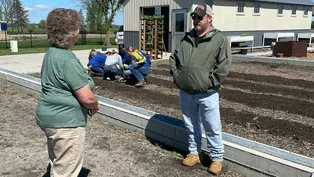
Preview: S36 Ep2 | 29s | Visiting the Local Foods Program at South Dakota State University in Brookings. (29s)
Providing Support for PBS.org
Learn Moreabout PBS online sponsorship

- Home and How To

Hit the road in a classic car for a tour through Great Britain with two antiques experts.









Support for PBS provided by:
Prairie Yard & Garden is a local public television program presented by Pioneer PBS
Production sponsorship is provided by ACIRA, Heartland Motor Company, Shalom Hill Farm, Friends of Prairie Yard & Garden, Minnesota Grown and viewers like you.